Novels You Have Missed or Forgotten

…And Need Before Your Next Quarantine

Pew Catherine lacey

This 2020 publication quietly slipped in and took a seat on the back row. Perhaps it has gone unnoticed because at barely more than 200 pages, and dressed up to look like a prayer book, it has literally been lost among the other books on the case. That’s too bad, because this little book has a lot to say.

The premise of the novel is how a small Southern town reacts when finding a homeless, gender-neutral person of uncertain ethnicity asleep on a church pew on Sunday morning. As various households extend hospitality to “Pew,” who also appears to be mute, confidences are shared that begin unraveling the town’s history. And oh, the hypocrisy (bless their hearts)! Packed with social and moral dilemmas, this novel provides plenty of fodder for  discussion at your next Book Club.


There, There Tommy orange

Tommy Orange is angry. Really angry. He’s angry about the plight of contemporary American Indians, and he wants everyone to read about it. He wants us to understand what it’s like to be caught between two worlds: one that you’re trying to preserve and another that doesn’t seem to want you.

And no, this is not an episode of Yellowstone. This is Tommy Orange’s debut novel, and besides bringing a meaningful perspective to the struggles of modern urban American Indians, it’s just plain good literature. He knocks it out of the park on his first try. Wow.

Mr. Orange speaks through twelve different characters, a strategy that is difficult to pull off but is impressively well-executed in this novel. Each character propels the main plot line while adding a different dimension to the saga. The end result is a perfectly-seasoned portrait that will stay with you long after you’ve finished the book.


florence adler swims forever rachel beanland

Rachel Beanland gives us another solid debut novel that didn’t quite get the recognition it deserves. It’s about a family who keeps the death of a daughter secret to protect her pregnant sister. I’ll admit I found that plot line a bit dubious at first. Then I read in the author’s note that the story is actually based on real events from her own family (so file that under “truth is stranger than fiction”).

The Adler family is Jewish, and the patriarch, Joseph, left family behind in Europe when he emigrated to America. It is now 1934, and in a secondary plot line, Joseph is feeling pressure to help a “family friend” escape Nazi Germany without revealing the true nature of her relationship to him. The novel’s impact is in demonstrating how family secrets can undermine relations between family members, even when intentions are pure.

As an added bonus, it paints a picture of the early boom years of Atlantic City, back when the town was, well, charming.


Prince of tides Pat conroy

Oh, I know — Prince of Tides is old news and was even made into a movie starring none other than Babs herself. But after everyone went gaga over Where the Crawdads Sing, I began to wonder if anyone remembered it anymore.

I’ll admit, Delia Owens, a nature writer, did an impressive job with her descriptive writing about the Outer Banks. But Conroy, a Southerner, writes about life on the South Carolina coast with real authenticity (and without the distraction of poorly-executed accents). You won’t find a backwoods loner in this story; but see, when backwoods parents stick around they can create lots more trouble, which in turn makes for a much more complex story line. One that only a New York City psychiatrist can untangle.  

Regardless of how you feel about the Crawdads, don’t miss the Tides. It’s equal parts painful and beautiful in a way you won’t forget.
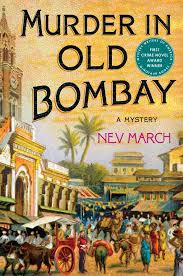
Murder in Old Bombay

Nev March

November 2020

oldbombaydNev March’s novel debuts with an award from the Mystery Writers of America in its wake, so snatching up an advance copy was not a difficult choice. The book lives up to its early praise, delivering intrigue enfolded in a complex and volatile political environment. The main characters are developed well as the novel progresses, and left me hoping to see them again in later publications.
This story is set in the British colonial period of the late 19th century. It includes a lot of history about that era. The political and religious divisions between the British and various Indian factions create complications that intensify the intrigue. There is an appendix at the back of the book with definitions of Indian terms used in the book; unfortunately, I was reading an e-book and was unaware of the appendix until I actually reached the end of the book. For this reason, I would recommend reading it in the physical book format to facilitate moving back and forth between the book and appendix.

Captain James Agnihotri has recently departed the British Army after recovering from battle injuries. During his extended hospital recovery in Bombay, he followed a story in the newspaper about the murder of two young Indian noblewomen and the ensuing trial, which ended in the acquittal of the accused. Compelled by a letter to the editor from the women’s husband and brother, Adi Framji, Captain Jim approaches him after being released from the hospital. Thinking he may be able to launch a career as a detective in the fashion of his idol, Sherlock Holmes, he offers to investigate deeper into the murders.

From there we are led on a delightfully complicated investigation, rife with side quests and soaked in Indian culture and history. We also learn about Captain Jim’s childhood as a British Indian orphan, and the cultural troubles that went along with it. The storyline even includes a risky cross-cultural romance.

In a time when so many of the modern mystery/thrillers seem to be formulaic, it’s refreshing to read one that actually challenges the reader. Doyle and Holmes would be impressed.

To learn more about author Nev March and the release of Murder in Old Bombay, visit the author’s website.

My thanks to Minotaur Books and Netgalley for providing an advanced reader copy for my unbiased review.

Inland

tea obreht

Inland is Tea Obreht’s second novel. Most of you will remember that her first novel, The Tiger’s Wife, received literary acclaim. I must admit that though there were elements of her first novel that I appreciated, it seemed that her attempt to meld folklore and reality into one story — difficult for any author to achieve — was a bit rocky and lacked cohesion. I was left feeling that even though the story was good, that one particular aspect was more distracting.

I wasn’t far into Inland before one character was seeing the dead, another was claiming to communicate with them, and a third was conversing with a dead child. My initial impression was not hopeful, yet I was sufficiently engaged to keep reading. The pay-off was not far away; soon the story organically brought me to consider the possibility of the dead cohabitating with the living.

Please don’t misunderstand; Inland is not a book just about the occult or mysticism. It is a modern-day Western that includes perspectives from all the early settlers of various backgrounds and ethnicities. One of the main characters, Nora, is a woman who has to deal with harsh daily life in the post-Civil War Arizona territory. The other main character, Lurie, is an outlaw Turk who evades the law while traveling the West on a camel (yes, there really were camels in the West after the Civil War). There are also Mexicans and Native Americans. Cowboys? A few, but this time they aren’t necessarily the good guys.

How do these two characters end up in the same book? It doesn’t seem likely, but Obreht pulls off this part of the storyline as well. Nora is a homestead housewife raising three children, plus her husband’s niece, under extremely harsh conditions. Her husband’s recent absence is complicating circumstances. As the novel continues, it becomes apparent that Nora has contentious relationships with just about everyone around her. A primary source of irritation: Josie, her husband’s niece, who claims to communicate with the dead. Nora is skeptical of Josie’s “talent” and refuses to allow her to hold seances in her home, while Nora herself has a running commentary with her dead daughter, Evelyn.

Lurie was orphaned as a young boy not long after arriving in America with his father. He remembers very little of his father and knows even less of his heritage. After meeting Jolly, a cameleer, some of the pieces of his past begin to fall into place. Lurie, however, is running from the law, and can’t stay in one place for long. He absconds with his beloved camel and ventures across the West for decades, his storyline finally merging with Nora’s near the end of the novel.


Inland provides us with a non-traditional perspective on life in the early American West that, despite incorporating a little fantasy, is probably a much more accurate depiction of history than we are accustomed to seeing. Obreht has developed her talent to also provide a compelling and innovative tale.

My thanks to NetGalley and Random House Publishing for providing an advance copy of this book in return for my unbiased review.

For more information on camels in the West, check out this article in the Smithsonian Magazine.

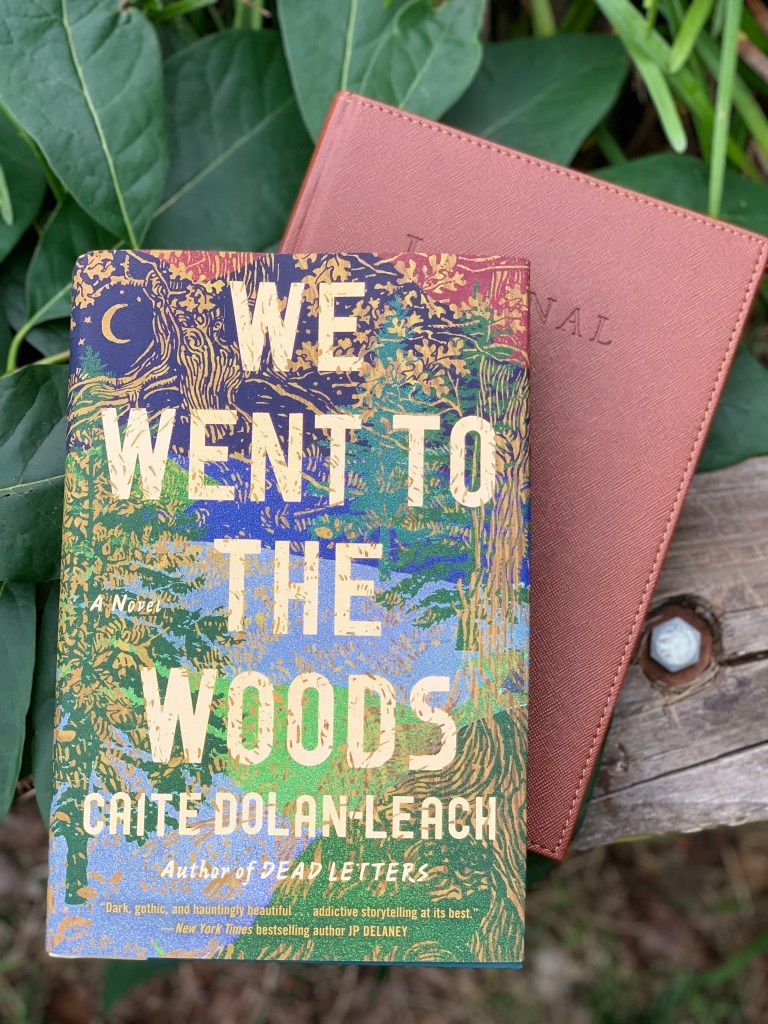
We Went to the Woods

Caite dolan-leach – July 2, 2019

Looking for a mid-summer novel with substance? Caite Dolan-Leach’s We Went to the Woods is your book. This novel, set in modern-day upstate New York, chronicles the struggles of five idealistic young adults who fearlessly tackle the issues of sustainability and the dangers of chemical farming. Each brings their individual strengths, as well as flaws, to the project.

The novel opens with the main character, Mackenzie, at loose ends after a public humiliation that ended her post-grad academic career. Mack has returned home to live with her parents when she meets a group of friends, two men and two women, who welcome her without asking too many questions about her recent past. The interrelationships within the group appear somewhat fluid from the onset. The group enjoys lively, idealistic discussions about socialist political theory, global warming, and sustainable food sources. Louisa emerges as the unacknowledged leader of the group. It’s after her invitation to visit her family “Homestead” in the woods that the five of them decide to embark on an experiment to create a self-sufficient, ecologically responsible compound that would eventually organically provide them with all their needs.

If creating such a Utopian compound sounds daunting — stay tuned, the fun has just started. The relationships within the group of five, which Mack finds confusing at first, create their own difficulties. Outside the Homestead, neighboring farm communities are both supportive and competitive. Misguided attempts at activism create havoc. And homesteading is just plain hard work, and sometimes quite dangerous.

Mack finds evidence of prior Utopian homesteaders in the area, and researches their attempts in comparison to those of her group and others in the area. In doing so, she learns what all these groups have in common, failures and successes. She also learns a little more about herself and comes to terms with her own recent failure. But is she destined to fail again with this project?

The novel leads us through four seasons of establishing the Homestead, which is a fascinating process in itself. This book also includes food for thought for anyone interested in sustainability, global warming, and chemical-free farming. These challenges are wrapped around a compelling tale of the interrelationships of five people and their encounters with the community.

My thanks to NetGalley and Random House for providing me with a review copy.

Why Half Magic?

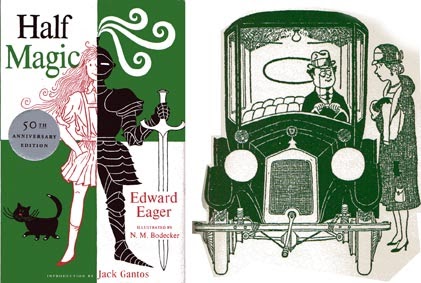
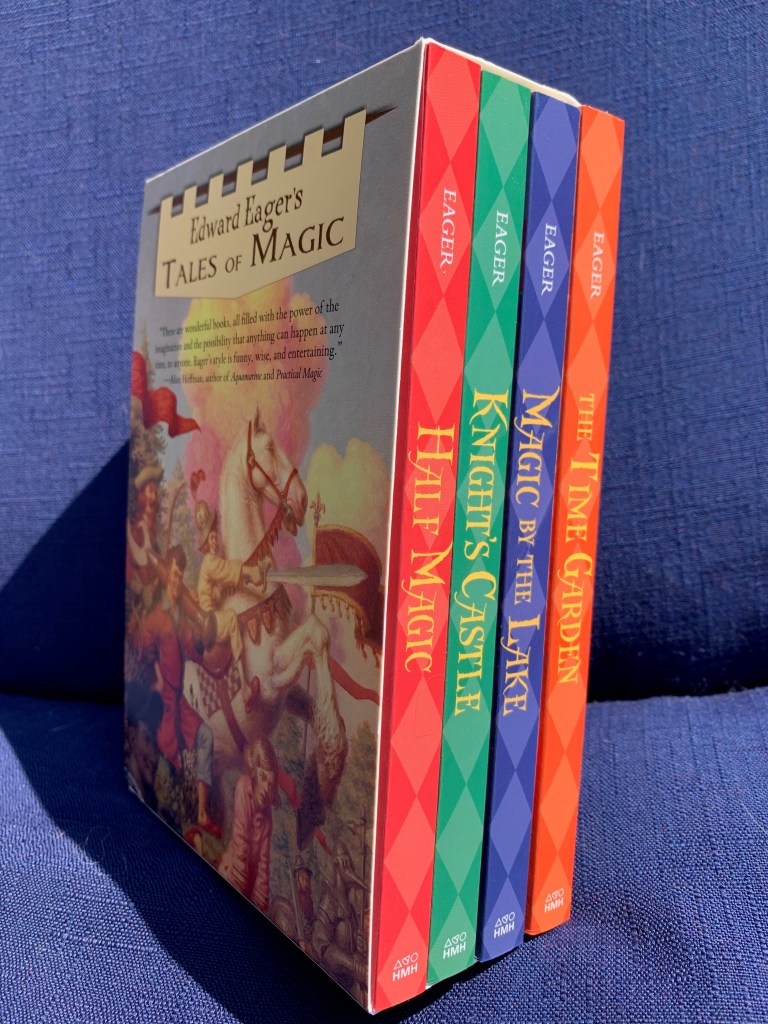
Half Magic by Edward Eager

Being the youngest in the family, most of my books growing up were well-loved hand-me-downs that were sometimes held together with a rubber band. That didn’t really matter to me — if a book is showing that much wear and tear, it must be a good one. But several times a year, I brought home one of those newspaper-y order forms from Scholastic Books, and I knew a NEW book was in my future.

That’s how Half Magic by Edward Eager first made its way into my library. I don’t remember how old I was when I first received it, but I know that for a good many years, it shared a special status with Little Women (Alcott) as my favorite books, worthy of reading…and re-reading…and re-re-reading….

When my own kids were in school, I looked for Half Magic at their school library, and found it. It was still around! My mom even dug up my old copy so my sons could read it, but they weren’t interested (it’s hard to compete with Captain Underpants (Pilkey) for a boy’s attention).

Fast forward a few decades. I’m now working as a bookseller. I walk past a holiday display of boxed book sets for children, and what do I find? Three more Edward Eager novels! Who knew? All those times I read the same novel over and over without ever guessing that there were more.

I know it’s a goofy title for a blog. I tried to think of other titles, taking into consideration my son’s warning that I would be one-upped when someone named their book blog “Entirely Magic.” But Half Magic was a really important book to me. You see, it was “below” my reading level when I got it, but I read it repeatedly simply because I enjoyed it, and that experience is probably why I have become a life-long reader. As a bookseller, I have frequently heard adults telling a child that they can’t have this book or that because it’s below their reading level — they have to challenge themselves. And you know what? That’s exactly what I said to my son when he brought home Captain Underpants from the Scholastic Book Fair. But then I remembered — can’t we read just for fun? Isn’t that half the magic?

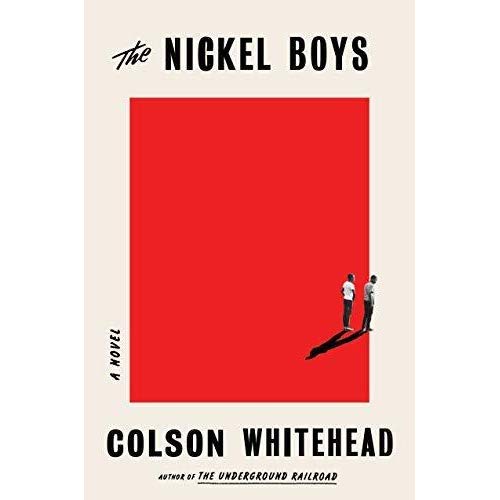
The Nickel Boys by Colson Whitehead

Release Date: July 16, 2019

Colson Whitehead’s (Underground Railroad) latest work of historical fiction, The Nickel Boys, is an alarming account of twentieth-century American reform schools. It is a commentary on how little value was placed on the lives of children; if the lives of all children were undervalued, those of African American children were tragically disregarded.

Whitehead’s novel is centered on the fictitious Nickel Reform School in Florida. The era of the opening of the novel is the Sixties. Nickel is based on the actual Arthur G. Dozier Reform School for Boys in Marianna, Florida, which was in operation from 1900-2011. The Dozier school became the subject of an investigation after a multitude of unmarked graves was discovered on the campus. Examination of the remains has confirmed the allegations of physical and sexual abuse initiated by a group of the school’s alumni.

The story is told through the experiences of Elwood Curtis, a talented and intelligent African American teenager with a promising future. His life takes a turn for the worse when he accepts a ride from a man driving a stolen car. The story jumps from the car ride to the reform school, without giving an explanation as to why Elwood’s innocence was never established, despite having attained legal representation. We want to know how this travesty of justice can happen to such a promising young man, but it is Whitehead’s decision to skip over the details that drives the point home — no one is interested in hearing about Elwood’s innocence, his success in school or his plans for the future. Elwood is labeled a problem kid and dispatched to reform school.

Soon after arriving at Nickel, Elwood makes friends with the street savvy Jack Turner. Their alliance makes it easier for each to navigate the perils of a still-segregated reform school. Jack admires the idealistic Elwood, a follower of Dr. Martin Luther King, Jr., but realizes that his naiveté makes him vulnerable to abuse from both peers and the corrupt staff. Even after Elwood is awakened in the middle of the night and conveyed to the “White House” for a brutal beating that lands him in the hospital, he remains determined to do more than merely survive. Together, Elwood and Turner undertake the risk business of reaching out for help to stop the abuse.

We know that Mr. Whitehead is a master story-teller, able to propel his tale at a quick pace while building the reader’s concern for his characters. By choosing to set his story in the Sixties, Whitehead is able to weave the story of a young man’s battle against continuing injustice with the struggles of Black America’s quest for equality. Though both white and black boys suffered horrible abuse in the very real Dozier Reform School, the recent excavations of unmarked graves have found three times the number of African American remains. The Dozier survivors are finally receiving a measure of redemption. Elwood and Turner eventually receive it, too — just not in the way you’d expect. Get ready for a plot twist that only a master story-teller can deliver.